
Creating an ad creative that looks professional is easy.
Creating an ad creative that gets attention, communicates value, builds trust, and drives action is much harder.
Many marketers focus heavily on design:
- Better images
- Better colours
- Better typography
- Better videos
- Better animations
But design is only one part of a successful advertisement.
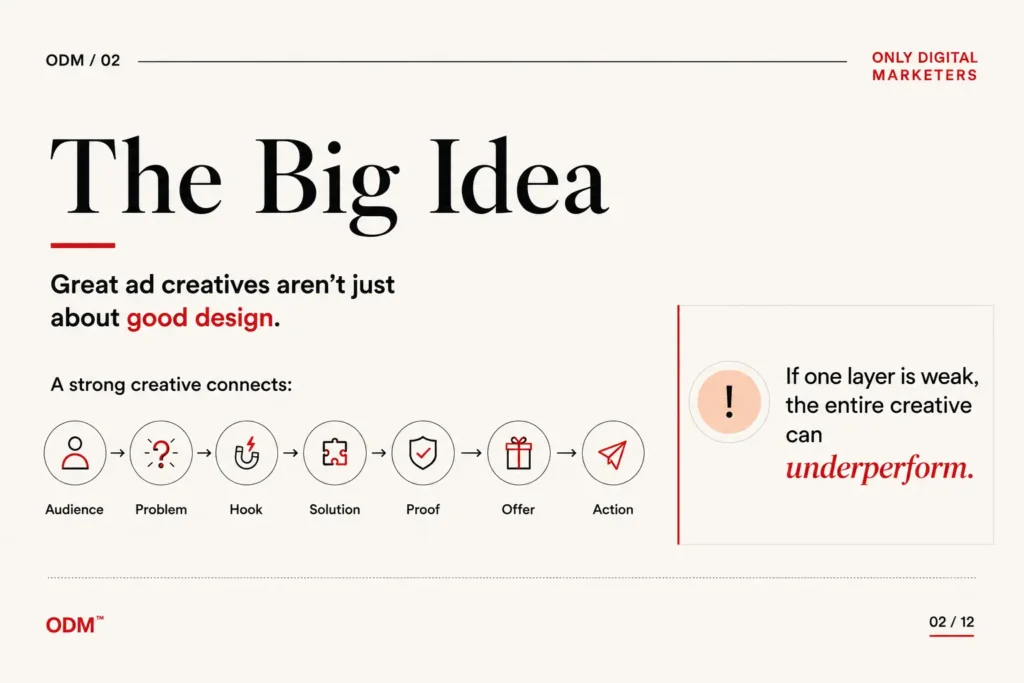
A high-performing ad creative needs to connect the right audience with the right problem, present a compelling hook, explain the solution, provide proof, communicate a strong offer, and finish with a clear call to action (CTA).
That’s why a useful way to improve your advertising creative is to break it into seven layers.
The 7-Layer Ad Creative Framework
If you want to know how to create better ad creatives, remember that a strong ad creative should answer these seven questions
- Audience: Who are you speaking to?
- Problem: Why should they care?
- Hook: Why should they stop scrolling?
- Mechanism: How does your solution work?
- Proof: Why should they believe you?
- Offer: What exactly are they getting?
- CTA: What should they do next?
Think of these layers as building blocks.
If one layer is weak, the entire ad can underperform.
If all seven work together, your creative has a much better chance of attracting attention and converting the right people.
What Makes an Ad Creative Effective?
Before getting into the seven layers, it’s important to understand what a good advertisement actually needs to accomplish.
A high-performing ad creative should:
Stop attention → Create relevance → Build curiosity → Explain value → Reduce doubt → Make the offer attractive → Drive action
This applies across different advertising formats, including:
- Meta Ads (Meta ads Creative Strategy)
- Facebook Ads
- Instagram Ads
- Google Display Ads
- LinkedIn Ads
- YouTube Ads
- Ecommerce advertising
- Lead generation campaigns
- B2B advertising
- Local business advertising
The format may change, but the fundamental psychology remains similar.
A beautiful creative that doesn’t communicate a relevant message won’t necessarily perform well.
1. Define Your Audience Before Creating the Ad
The first step in creating better ad creatives is knowing exactly who the advertisement is for.
One of the biggest mistakes advertisers make is using broad audience descriptions.
For example:
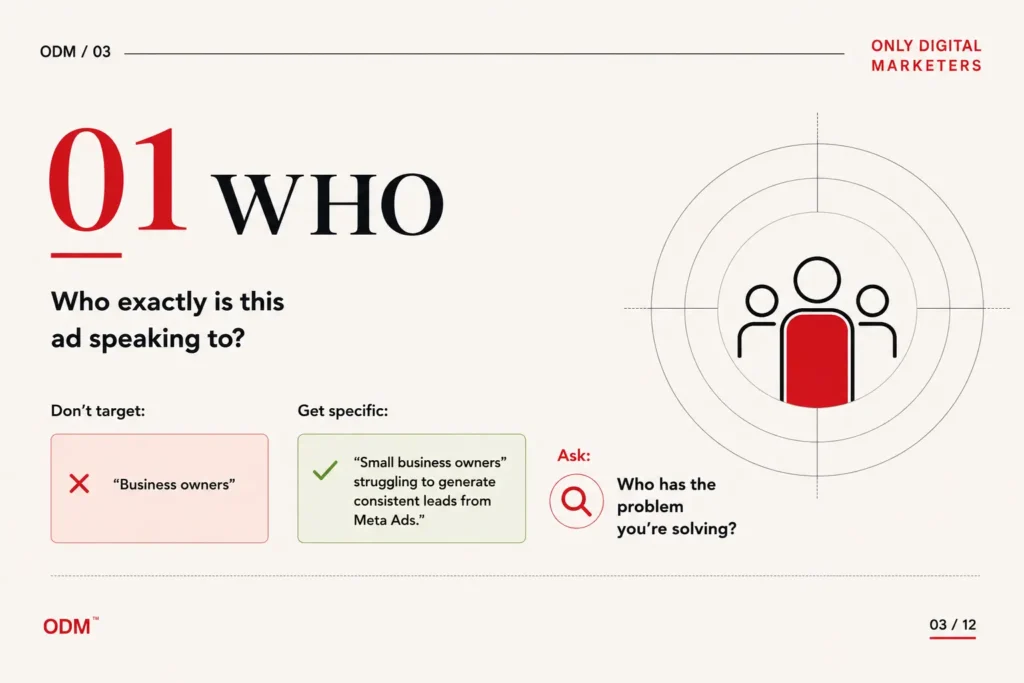
“Business owners”
That’s too broad.
A better audience description might be:
“Small business owners struggling to generate consistent leads from Meta Ads.”
Now you have a much clearer picture.
You know:
- Who they are
- What they’re trying to accomplish
- What platform they’re using
- What problem they’re experiencing
- What outcome they want
This makes it much easier to create relevant ad copy and visuals.
Don’t Ask Only “Who Is My Customer?”
Go deeper.
Ask:
- What are they trying to achieve?
- What frustrates them?
- What have they already tried?
- What are they afraid of?
- What is costing them money?
- What outcome do they want?
- What would make them stop scrolling?
- What language do they use to describe the problem?
This research becomes the foundation for your ad messaging and creative strategy.
Weak targeting
Business owners
Better targeting
Small business owners running Meta Ads but struggling to generate qualified leads.
The second statement gives you far more information to work with.
Quick test
Ask:
“Would my ideal customer immediately recognize that this ad is meant for them?”
If not, your audience definition probably needs more work. Read this article to find your target audience (Your ICP – Ideal Client Profile)
2. Identify the Problem That Makes Them Care
Once you’ve identified your audience, determine why they should care about your advertisement.
Your customer doesn’t wake up wanting your product.
They want a solution to a problem or a path toward a desired outcome.
For example, a digital marketing agency might say:
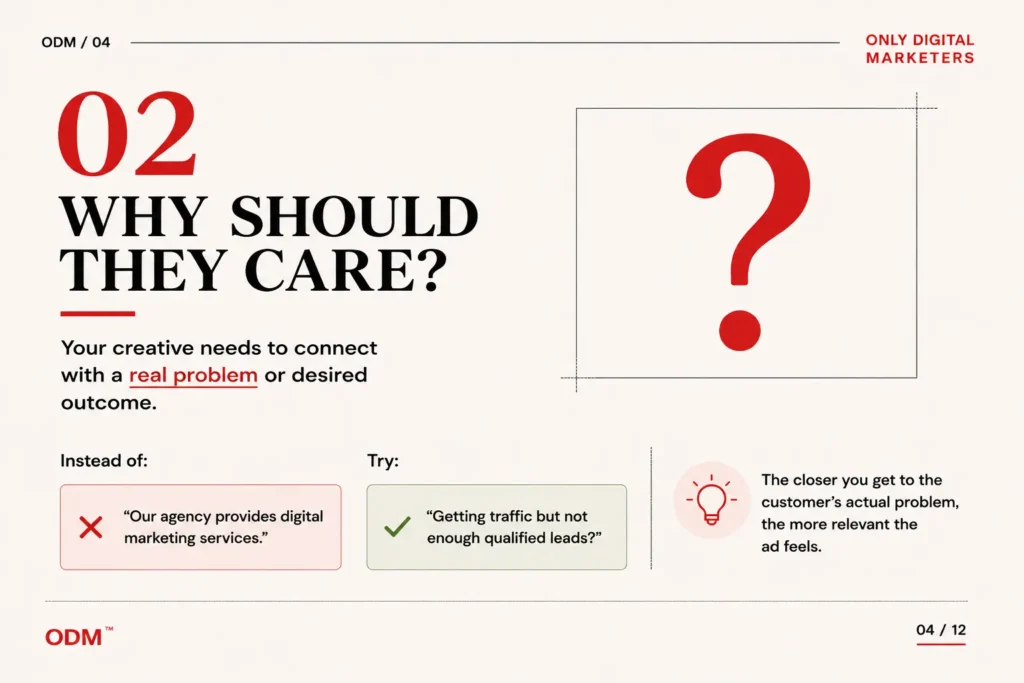
“We provide SEO, Google Ads, Meta Ads and digital marketing services.”
That’s a description of the company.
It’s not necessarily a compelling advertising message.
Instead, you could address the customer’s actual problem:
“Getting traffic but not enough qualified leads?”
Now you’re talking about something the customer may already be experiencing.
Go Beyond the Surface Problem
Good ad messaging often becomes stronger when you move beyond the obvious problem.
For example:
Surface problem:
“My cost per lead is too high.”
Deeper problem:
“I’m spending too much money on leads that don’t become customers.”
Desired outcome:
“I want a predictable flow of qualified leads without continually increasing my advertising budget.”
That deeper understanding can dramatically improve your ad copy.
Problem vs. Product-Centric Messaging
Product-centric
“Our agency provides performance marketing services.”
Customer-centric
“Spending more on ads but still struggling to generate qualified leads?”
The second version is more likely to capture attention because it starts with the customer’s situation, not the company’s credentials.
That’s a critical principle in effective advertising:
Talk about the customer’s problem before talking about your product. Read this article to find your customer’s pain points (Your ICP – Ideal Client Profile)
3. Create a Hook That Stops the Scroll
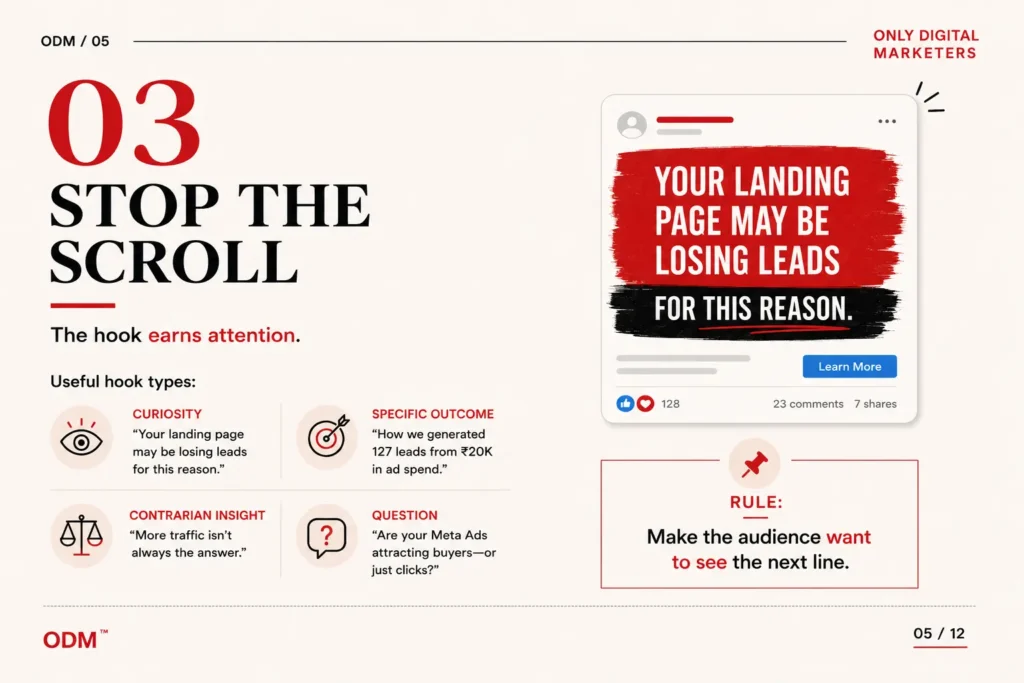
Even if your audience has a genuine problem, they won’t engage with your advertisement unless something earns their attention.
That’s the job of the hook.
The hook is the first message, visual, statement, question, or idea that makes someone pause.
For social media advertising, this is particularly important because you’re competing against an endless stream of content.
Four Useful Ad Hook Types
1. Curiosity Hook
Create an information gap.
“Your landing page may be losing leads for this reason.”
The reader wants to know the reason.
2. Specific Outcome Hook
Lead with a concrete result.
“How we generated 127 leads from ₹20K in ad spend.”
Specific numbers can make a claim more tangible.
3. Contrarian Hook
Challenge a commonly held belief.
“More traffic isn’t always the answer.”
This works because it creates tension between what the audience expects and what you’re suggesting.
4. Question Hook
Ask a question that reflects the customer’s situation.
“Are your Meta Ads attracting buyers—or just clicks?”
The best questions make the reader mentally answer them.
Your Hook Has One Job
Don’t try to explain your entire offer in the first sentence.
The hook needs to make the audience want to consume the next piece of information.
Think of it as a chain:
Hook → Curiosity → Explanation → Proof → Offer → Action
A weak hook breaks the chain before the person even sees your message. Read this article to research better ad hooks based on your industry.
4. Explain the Mechanism Behind Your Solution
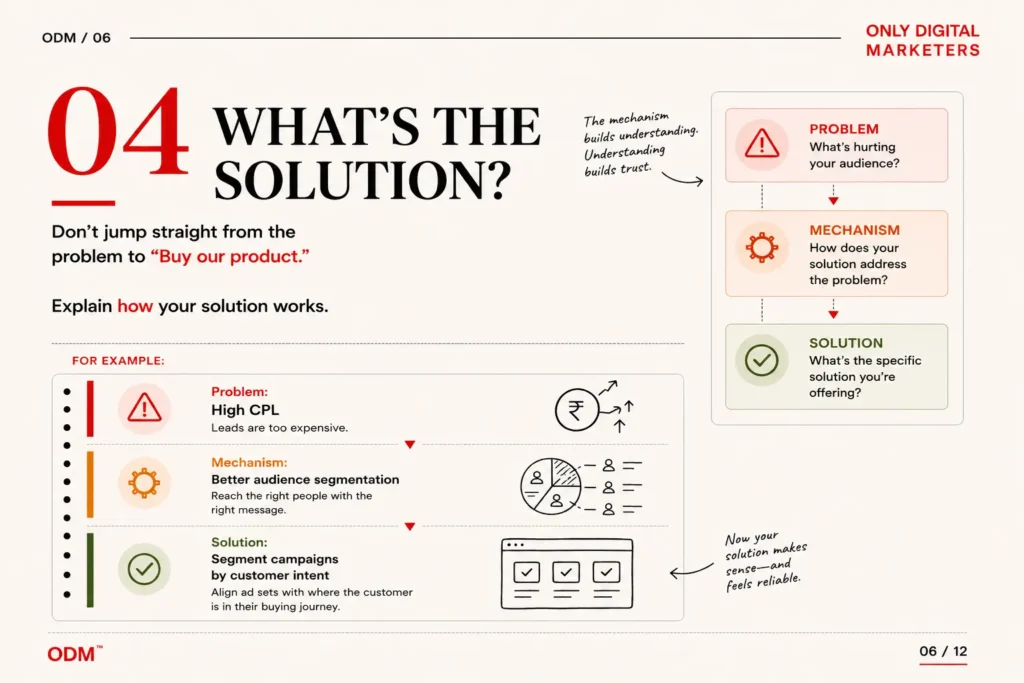
This is one of the most overlooked elements of an effective ad creative.
Many advertisements jump from:
Problem → Buy our product
That’s a big psychological leap.
The audience may still be thinking:
“Why would this actually work?”
That’s where the mechanism comes in.
The mechanism explains how your solution addresses the problem.
For example:
Problem
High cost per lead.
Mechanism
Better audience segmentation.
Solution
Segment campaigns based on customer intent.
Now the advertisement has a logical progression:
High CPL → Poor audience targeting → Better segmentation → More relevant campaigns → Better lead quality
The mechanism gives the audience a reason to believe that your solution isn’t random.
Why the Mechanism Matters
A useful advertising structure is:
Problem → Mechanism → Solution
For example:
Problem:
Your Meta Ads are generating expensive leads.
Mechanism:
Your campaigns are reaching people with different levels of buying intent.
Solution:
Segment campaigns and messaging based on customer intent.
This is much stronger than simply saying:
“Use our Meta Ads service.”
The customer now understands why your solution could work.
5. Use Proof to Build Credibility
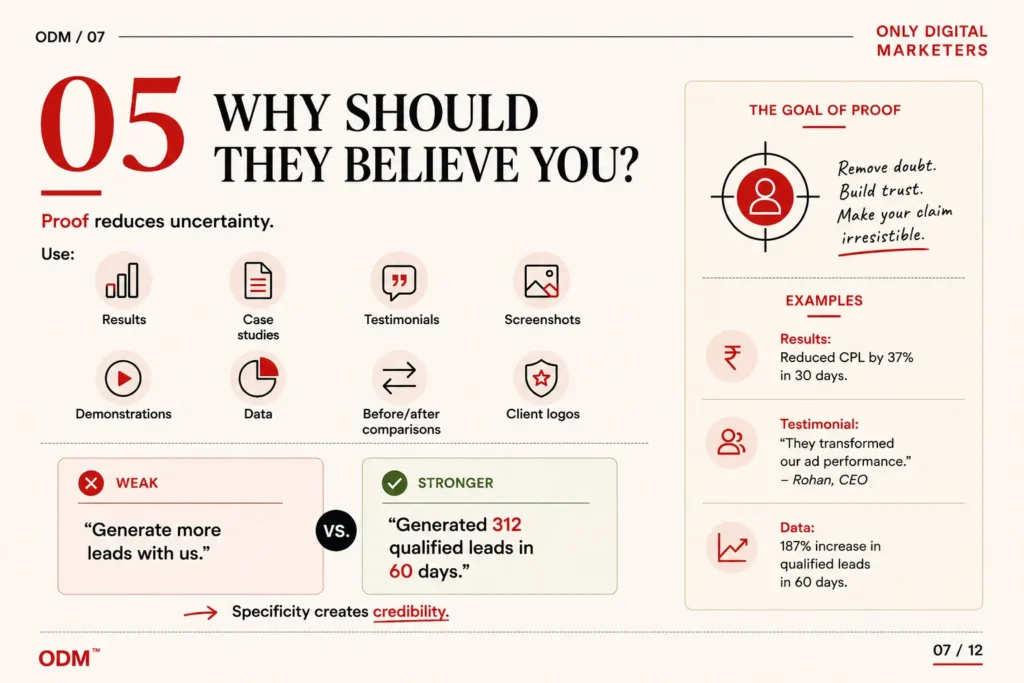
The next question your audience is likely to ask is:
“Why should I believe you?”
That’s where proof comes in.
Anyone can make a marketing claim.
Proof reduces uncertainty.
Useful types of advertising proof include:
- Customer testimonials
- Case studies
- Campaign results
- Screenshots
- Reviews
- Demonstrations
- Before-and-after comparisons
- Client logos
- Data
- Performance metrics
- Product demonstrations
- Third-party validation
Specificity Makes Claims Stronger
Compare these two statements:
Weak
“Generate more leads with us.”
Stronger
“Generated 312 qualified leads in 60 days.”
The second statement is more specific.
It gives the audience something concrete to evaluate.
Another example:
Weak
“We dramatically improve ad performance.”
Stronger
“Reduced CPL by 37% in 30 days.”
The lesson isn’t to add random numbers to your ads.
Use specific numbers only when they’re genuine and can be supported.
False claims might make an advertisement look impressive, but they destroy trust.
Read More : How Social Proof helps in Selling more
6. Build an Offer People Understand
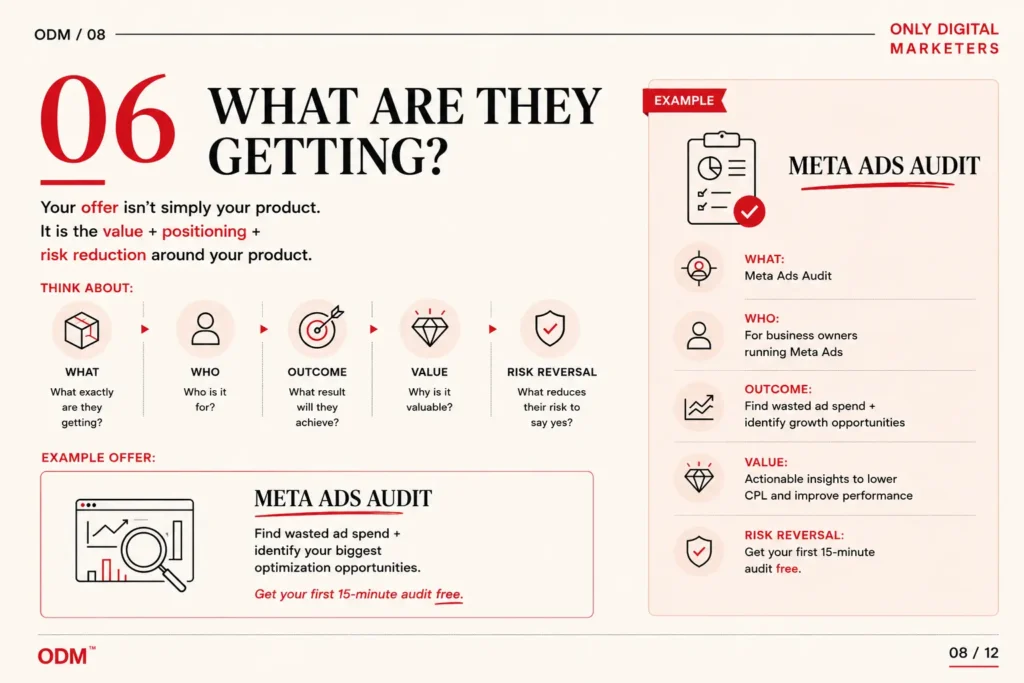
Your product isn’t necessarily your offer.
Your offer is the complete value proposition surrounding the product or service.
It includes things such as:
Value + Positioning + Outcome + Risk Reduction
For example, instead of advertising:
“Meta Ads Management Services”
you could create a more tangible offer:
Meta Ads Audit
Find wasted ad spend and identify your biggest optimization opportunities.
Get your first 15-minute audit free.
Now the audience can understand what they’re actually getting.
The offer answers five questions:
What?
What exactly are you offering?
Who?
Who is it designed for?
Outcome?
What result can they expect?
Value?
Why is it valuable?
Risk reversal?
What reduces the risk of taking the next step?
Your Offer Should Reduce Friction
People don’t automatically want to buy.
They have questions and objections.
For example:
- Will this work for my business?
- Is it worth the money?
- How difficult is it?
- What happens if it doesn’t work?
- Can I trust this company?
- What exactly am I getting?
A good offer addresses as many of these concerns as possible before the customer has to ask.
That’s why risk reversal can be powerful.
Examples include:
- Free audit
- Free consultation
- Free trial
- Money-back guarantee
- Sample
- Demo
- No-obligation assessment
The appropriate approach depends on your business and what you can genuinely offer.
Read More : How To Create Better Offers
7. Make the CTA Obvious
You’ve captured attention.
You’ve explained the problem.
You’ve presented the solution.
You’ve built credibility.
You’ve made the offer.
Now what?
Tell them.
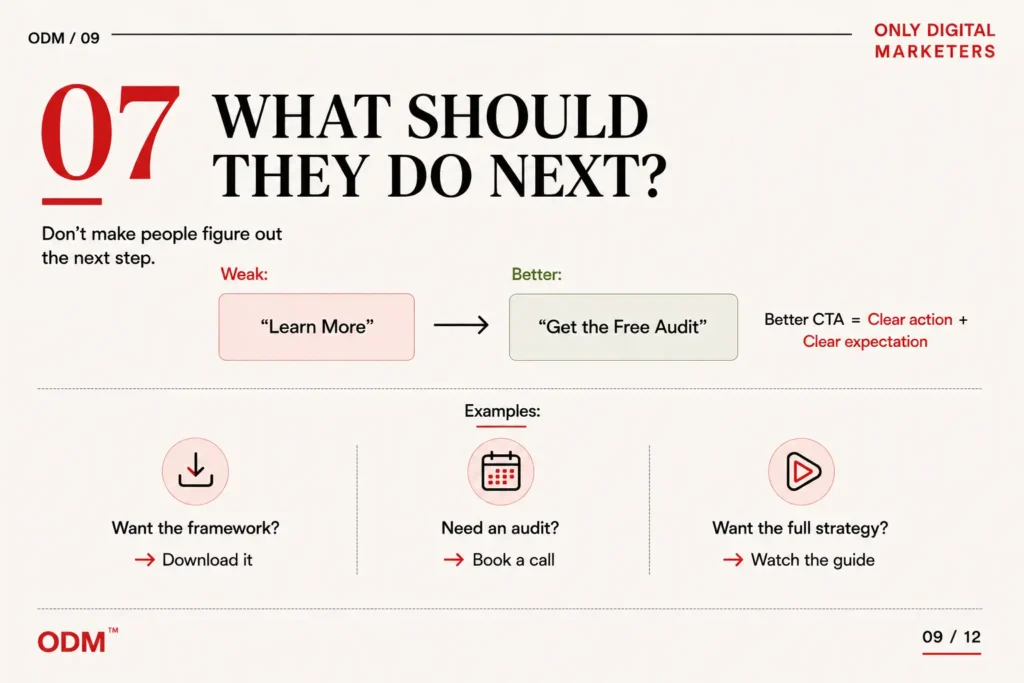
Don’t make the audience figure out what happens next.
Compare:
Weak CTA
Learn More
Stronger CTA
Get the Free Audit
The second CTA tells the person both:
What to do + What they’ll get.
That’s much clearer.
Better CTA = Clear Action + Clear Expectation
Examples:
Want the framework?
→ Download it.
Need an audit?
→ Book a call.
Want the full strategy?
→ Watch the guide.
Want to see the pricing?
→ View pricing.
Ready to get started?
→ Start your free trial.
Your CTA should remove ambiguity.
Read More : 15 CTA best practices to increase conversions
The Complete 7-Layer Ad Creative Framework
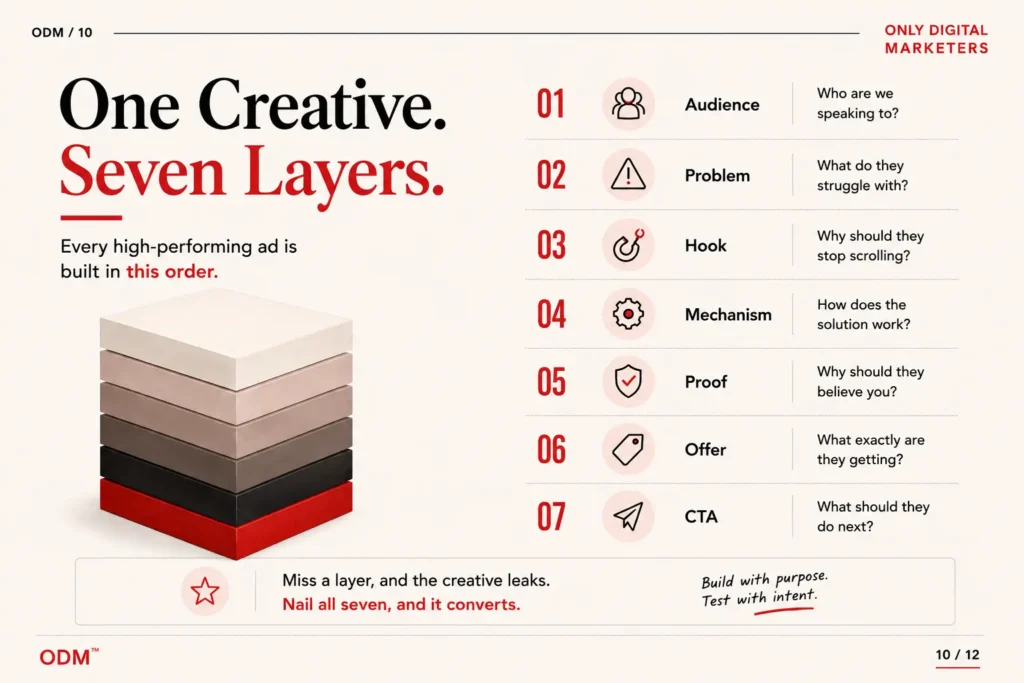
Here’s the entire framework at a glance:
| Layer | Question | What to Focus On |
|---|---|---|
| 1. Audience | Who are we speaking to? | Specific customer |
| 2. Problem | Why should they care? | Pain point or desired outcome |
| 3. Hook | Why should they stop scrolling? | Curiosity, outcome, question, tension |
| 4. Mechanism | How does the solution work? | Reason and process |
| 5. Proof | Why should they believe you? | Results, testimonials, data |
| 6. Offer | What exactly are they getting? | Value, outcome, risk reduction |
| 7. CTA | What should they do next? | Clear action |
Together, these seven elements create a complete ad creative framework.
How to Create Better Ads Creative Without Starting From Scratch
Here’s where this framework becomes especially useful.
When an advertisement doesn’t perform, many marketers immediately create an entirely new creative.
That’s often unnecessary.
Instead, diagnose the creative first.
Break the advertisement into its seven layers.
Then identify the weakest one.
For example:
Scenario 1: Low CTR
Your audience may be right, but your hook isn’t strong enough.
Test a new hook.
Scenario 2: High CTR but poor conversion
People are interested enough to click, but something after the click isn’t matching expectations.
Review:
- Problem
- Mechanism
- Offer
- Landing page
- CTA
Scenario 3: Good engagement but poor lead quality
Your advertisement may be attracting attention from the wrong people.
Review the:
Audience + Problem + Offer
Scenario 4: People understand the offer but don’t trust it
Your proof layer may be weak.
Add:
- Case studies
- Testimonials
- Results
- Screenshots
- Demonstrations
Scenario 5: People engage but don’t take action
Your CTA or offer may be unclear.
Make the next step more specific.
Don’t Change Everything at Once
This is one of the biggest mistakes in ad creative testing.
Imagine your original ad has:
- Audience A
- Problem A
- Hook A
- Mechanism A
- Proof A
- Offer A
- CTA A
Then you create another ad changing all seven.
If the new ad performs better, what did you learn?
Almost nothing.
Instead, create a hypothesis.
For example:
“The current creative isn’t generating enough clicks because the hook isn’t specific enough to the audience’s problem.”
Then change the hook.
Now you’re running a meaningful creative test.
This turns advertising from guesswork into a creative optimization process.
The 35-Point Creative Audit
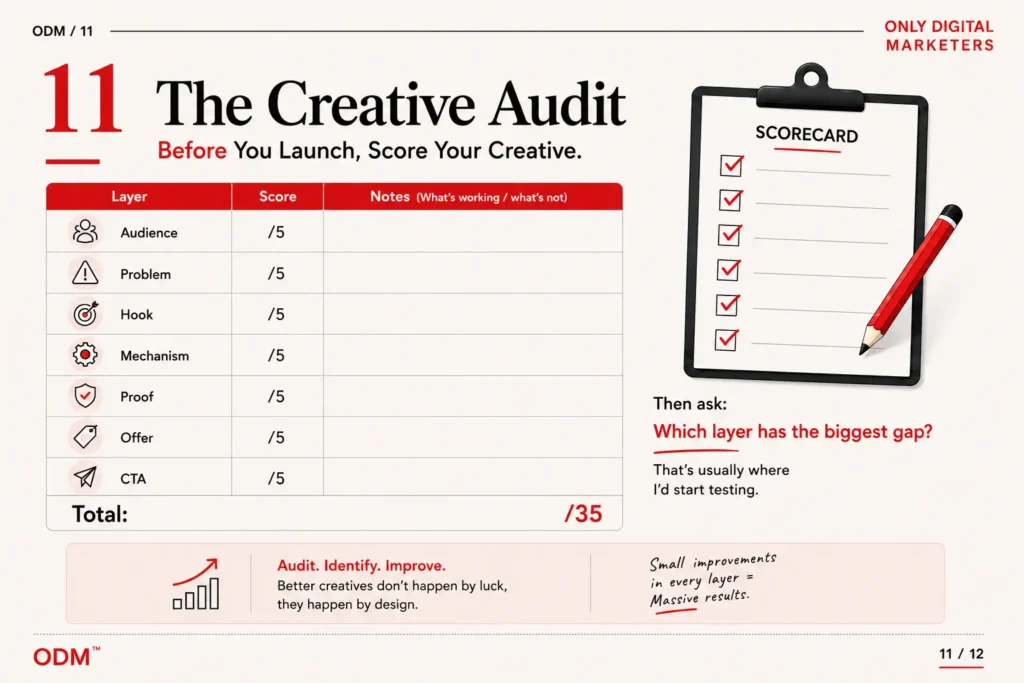
Before launching an ad, score each layer from 1 to 5.
Audience
__/5
Is the target customer specific?
Problem
__/5
Does the ad address a real pain point or desired outcome?
Hook
__/5
Would it make the target audience stop scrolling?
Mechanism
__/5
Does the audience understand how the solution works?
Proof
__/5
Is there enough evidence to support the claim?
Offer
__/5
Is the value clear and compelling?
CTA
__/5
Is the next action obvious?
Total
__/35
But don’t focus only on the total score.
The more important question is:
Which layer has the biggest gap?
That’s where you should usually begin testing.
Example: Improving a Meta Ad Creative
Let’s take a generic digital marketing agency advertisement.
Version 1: Weak Creative
Headline
Grow Your Business With Meta Ads
Body
We are a digital marketing agency helping businesses grow online.
CTA
Learn More
There’s nothing technically wrong with this advertisement.
But it is generic.
It doesn’t clearly identify:
- Who it’s for
- What problem it solves
- Why someone should stop
- How the solution works
- Why the company should be trusted
- What the person is getting
- What happens after clicking
Now apply the seven-layer framework.
Version 2: Framework-Based Creative
Audience
Small businesses already running Meta Ads.
Problem
They’re spending money but aren’t generating enough qualified leads.
Hook
Your Meta Ads may not have a budget problem.
Mechanism
Better audience segmentation can help you reach people based on different levels of buying intent.
Proof
312 qualified leads generated in 60 days.
Only use this if it reflects a genuine result.
Offer
15-Minute Meta Ads Audit
Find wasted ad spend and identify your biggest optimization opportunities.
CTA
Get Your Free Audit
Now the creative has a logical narrative.
Audience → Problem → Hook → Mechanism → Proof → Offer → CTA
That’s the difference between simply making an advertisement and strategically building one.
How the 7 Layers Work Together
The seven layers aren’t isolated.
Each one prepares the audience for the next.
Audience creates relevance.
“This is for me.”
Problem creates recognition.
“I have this problem.”
Hook creates attention.
“That’s interesting.”
Mechanism creates understanding.
“Now I understand how this could work.”
Proof creates trust.
“They’ve actually done this.”
Offer creates desire.
“This is worth considering.”
CTA creates action.
“Here’s what I should do next.”
That’s the journey your ad creative should take the audience through.
Ad Creative Is More Than Design
This is probably the most important takeaway.
A creative can have:
- Beautiful typography
- Perfect spacing
- Professional photography
- Great colours
- Excellent graphic design
…and still be a terrible advertisement.
Why?
Because good design doesn’t automatically create good advertising.
Design helps communicate the message.
It doesn’t replace the message.
The strongest high-converting ad creatives combine:
Good strategy + strong messaging + relevant visuals + clear positioning + compelling offer + effective CTA
That’s why you should stop asking only:
“Does this ad look good?”
Start asking:
“Does every layer of this ad do its job?”
A Practical Creative Testing Process
Use this process whenever an ad isn’t performing.
Step 1: Break it down
Separate the advertisement into the seven layers.
Step 2: Score each layer
Give every component a score from 1–5.
Step 3: Find the weakest layer
Look for the biggest gap.
Step 4: Create a hypothesis
Explain why that layer might be limiting performance.
Step 5: Change one major variable
Create a variation specifically designed to address the hypothesis.
Step 6: Launch the test
Compare the relevant performance metric.
Depending on the layer you’re testing, that could include:
- CTR
- CPC
- Conversion rate
- Cost per lead
- Lead quality
- ROAS
- Purchases
- Engagement
Step 7: Document the learning
Don’t just record which ad won.
Record why you believe it won.
That’s how your creative testing becomes a repeatable system.
You May Also Like To Read:
- PPC Prompt Library – Prompt to be better at paid media
- Explore Performance Marketing in detail
7 Questions to Ask Before Launching Any Ad
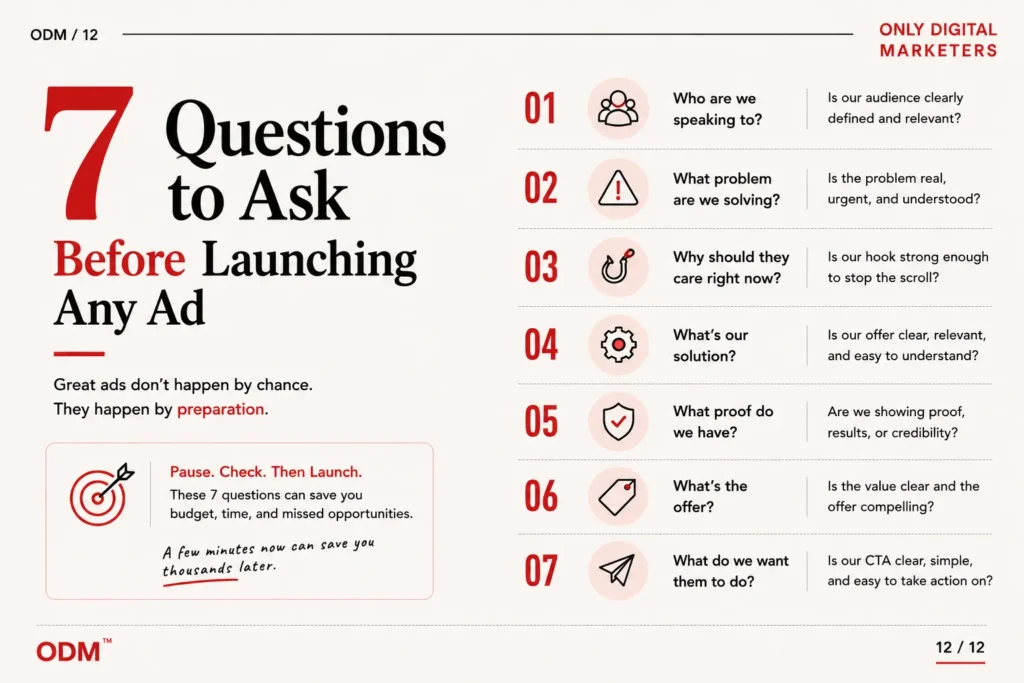
Before you publish your next advertisement, ask:
1. Who exactly is this ad for?
If the answer is “everyone,” start again.
2. What specific problem are we addressing?
Don’t hide behind generic marketing language.
3. Why would someone stop scrolling?
If your hook sounds like every competitor’s ad, it needs work.
4. Does the customer understand how the solution works?
Explain the mechanism.
5. Why should they believe us?
Add credible proof.
6. What exactly are they getting?
Make the offer tangible.
7. What should they do next?
Give them one clear CTA.